Phillis Wheatley wrote poetry while enslaved. Now, she graces a postage stamp.
Phillis Wheatley’s legacy of literary excellence was imprinted long before the U.S. Postal Service dedicated a stamp in her honor.
It is particularly gratifying to see how the influence of a dynamic woman who lived in the 18th century has endured so compellingly. This was clear from a Jan. 30 ceremony hosted by a hallowed hub of Black education, the Phillis Wheatley Literary and Social Club.
Wheatley’s inspiration burns most brightly in DeLaris Risher, the 95-year-old president of the club. Mrs. Risher was one of two women who integrated Scarritt College for Christian Workers in Nashville, Tennessee, two years before the landmark 1954 Brown v. Board of Education decision. In Charleston, she is beloved not only as an educator but also as a tireless advocate for literacy.
Why We Wrote This
To celebrate Black History Month as well as America’s 250th anniversary, the United States Postal Service chose Phillis Wheatley for the latest stamp in its Black Heritage series. Enslaved in Boston in the mid-1700s, Wheatley learned to read and write, and contributed poems that capture the revolutionary fervor of the era. Her legacy inspires educators today.
“You won’t believe it, but I tutored students at the [Charleston] Progressive Academy for the year, and their test scores jumped up,” Mrs. Risher said to audience applause. “Phillis Wheatley may be deceased, but her name will go on forever.”
The Wheatley stamp is the 49th in the postal service’s Black Heritage series, which includes luminaries such as Muhammad Ali and Malcolm X. Three South Carolina cities participated in the Wheatley stamp ceremony late last month – Charleston, Columbia, and Greenville. The event in Charleston took place at the Avery Research Center, founded in 1865 as the Avery Normal Institute, which was Charleston’s first free secondary school for African Americans. It was established a full century after Wheatley’s birth.
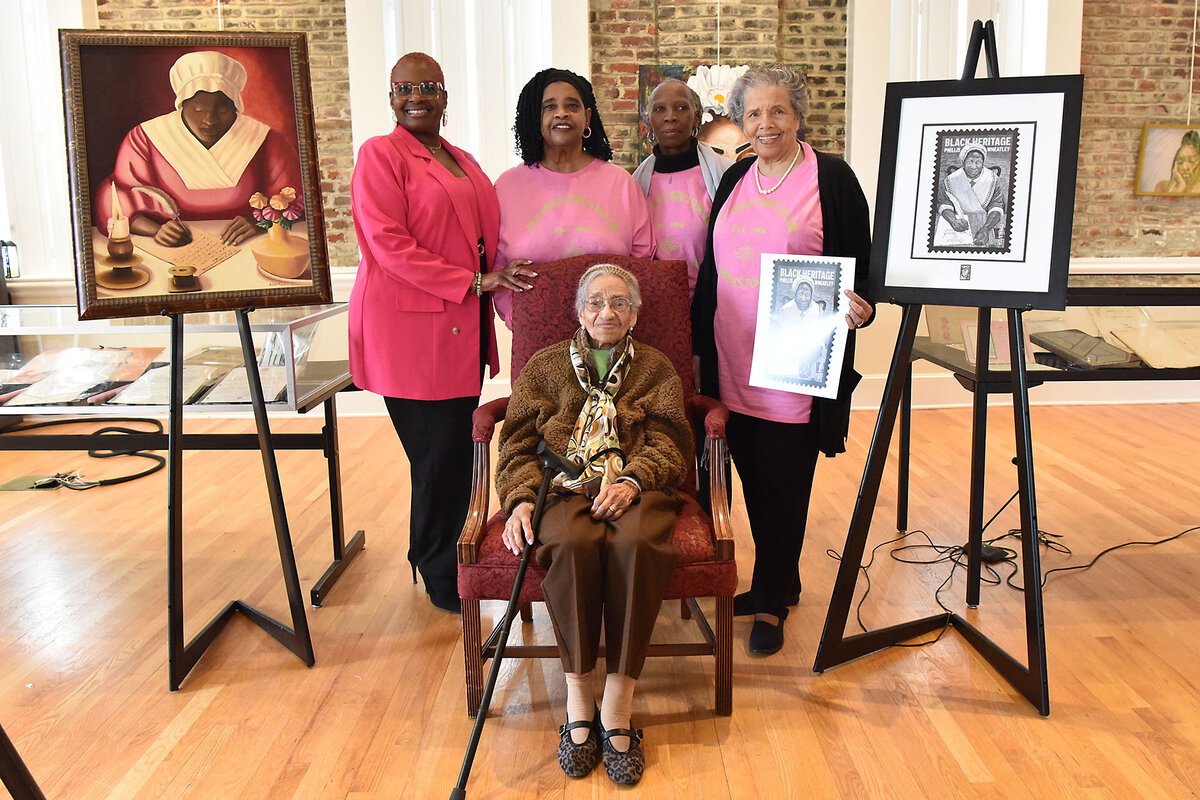 Ken Makin
Scholars say that while the exact date and place of Wheatley’s birth are unclear, they believe she was born in 1753 in West Africa, in what is now known as Gambia or Senegal. She was sold into slavery at the age of 7 or 8 and forcibly transported to Boston. Phillis was purchased by tailor John Wheatley to be a domestic servant for his wife, Susanna, who taught the girl to read. Phillis and her aptitude for learning breached the surface of her enslavement.
By age 12, Phillis began to publish her poems, and with Susanna’s help, began posting advertisements for her first book of poetry. However, the Wheatleys ultimately had to go to London to find a publisher because of Colonial racism.
Her first book, “Poems on Various Subjects, Religious and Moral,” was published in London in late 1773, and she was freed from slavery a year later. However, a lack of financial support belied the international acclaim she received for her poetry.
Wheatley’s life and works are synonymous with highlighting America’s 250th anniversary, explains preservationist and event organizer Catherine Fleming Bruce.
“Even though Phillis Wheatley never stepped foot here [in South Carolina], she has a footprint here,” Ms. Bruce says. “Those of us who pay a lot of attention to history and to the American Revolution are aware of her, but we’re often surprised to see that other people around us don’t have that awareness. This is an opportunity … to keep her legacy alive.”
It’s fitting that Mrs. Risher, with her Nashville roots, would still carry the torch of Wheatley’s legacy. The first Phillis Wheatley club, a women’s group created for African Americans, was established in 1895, and a number of such organizations took on social justice issues, such as voting rights and desegregation, as well as training Black professionals.
The Phillis Wheatley club in Charleston was formed in 1916 by Jeannette Cox, the wife of Benjamin Cox, who was the second Black principal at Avery Normal Institute. The club’s efforts drew the attention of sociologist W.E.B. DuBois, who sent the group a letter dated on Valentine’s Day in 1925:
I have heard of the anniversary of the Phyllis Wheatley Club of Charleston and as I have already known its hospitality I hasten to send greetings and good wishes. I am sure that if Phyllis herself could look in upon you today she would be uplifted beyond her wildest dreams for she must have been a very lonely little girl there in Boston with scarce a soul of her own race and blood to speak to; while if she lived today she would have all that you have and that, despite everything, is a very great deal.
Tammy McCottry, a member of the social club in Charleston who was present for the stamp ceremony, reflected upon the various links between the past and the present.
“People should know that Phillis Wheatley was enslaved and how badly she wanted to be free. They should know that her poems speak volumes, even to what’s happening today in America,” she said. “People need to know that, especially our young people.”
The intersection between sociopolitics and literacy also drew elected officials to the event in Charleston, including a former English teacher – South Carolina state Rep. Courtney Waters. She remarked upon the drop in modern-day literacy rates, and said she believed that Wheatley’s story might inspire excellence.
“My first love was books, and to be in this moment of serving the legislature where they’re stripping away our access to history and aren’t responding to the deficits in our education system. ... It is so important that we are actually honoring a legacy of literary excellence,” she says. “Because that means something. And it’s a history that you can’t erase.”
Deepen your worldview
with Monitor Highlights.
Already a subscriber? Log in to hide ads.
Ultimately, the story of education for Africans in America is one of self-reliance and remarkable determination, as evidenced by Wheatley, the Avery Institute, and many other revolutionary examples.
“We have to remember ourselves, particularly in this moment. ... [Black people’s] struggle really set the tone for what anybody who’s in a marginalized situation can do. We built for ourselves,” Representative Waters says. “It didn’t matter what it looked like, it didn’t matter what the conditions were, they [Black teachers] were gonna teach our children. I think that we have to remember that we are a people designed to persist to excel.”