Quebec separatist says no independence referendum while Trump in office
Quebec separatist says no independence referendum while Trump in office
The leader of Quebec’s secessionist party says the debate over his province’s independence has been stymied by turbulence in US politics.
Save
 President Donald Trump speaks with Canadian Prime Minister Mark Carney at a G7 meeting in France on June 16 [Evelyn Hockstein/AP Photo, pool]
The head of a major secessionist party in the Canadian province of Quebec has promised not to hold a referendum on independence until United States President Donald Trump has left office.
Parti Quebecois (PQ) leader Paul St-Pierre Plamondon said on Tuesday that debate over the issue could only proceed calmly once Trump is no longer president.
Recommended Stories
list of 3 itemsend of list“It must not be hijacked by the upheavals of American politics, nor by the outbursts of an unpredictable president, nor by fear campaigns,” St-Pierre Plamondon said. “This unpredictability of the American administration will harm our process as well as the quality of the debate on our future as a nation.”
Quebec must hold its next provincial election by October 5, and the Parti Quebecois is hoping to make gains at the ballot box.
Polls currently suggest it is leading the province’s Liberal Party and the Coalition Avenir Quebec, which has the greatest number of seats in Quebec’s National Assembly.
St-Pierre Plamondon affirmed that he intended to seek an independence referendum should his party win this year.
But such a vote, he said, would wait until later in the four-year term, after Trump’s second term concludes in January 2029.
Since returning to the presidency in 2025, Trump’s hostility towards Canada has redefined cross-border relations.
Trump has repeatedly voiced controversial opinions about turning the country into a 51st US state, and has used tariffs on Canadian goods as leverage to advance policy demands.
Negotiations on Tuesday are ongoing as Canadian officials seek to head off Trump’s latest tariff threat, which would place 50 percent import taxes on a range of goods starting at midnight on Wednesday.
AdvertisementThe growing friction between the US and Canada has placed secessionist movements in places like Alberta and Quebec in a difficult position.
Trump’s actions have sparked a surge in Canadian nationalism, as citizens express anger at US policy.
There has also been speculation that the US may encourage secessionist efforts in provinces like Alberta, where right-wing leaders like Premier Danielle Smith hold significant sway.
While residents of Quebec have long pushed for greater sovereignty, experts say that the economic benefits of maintaining a union with Canada may become more appealing given the turbulence unleashed by the US.
“Triggering [a referendum on independence] while Trump remains in the White House would have been particularly risky,” Daniel Beland, a political science professor at McGill University in Montreal, told The Associated Press news service.
“Support for independence in Quebec remains at around 30 percent, and the fact that the PQ is ahead in the polls is not a sign that support for independence is increasing,” he added.
Iran war live: Trump denies Iran talks, Tehran claims US ‘begging’
Al Jazeera reports from Indonesia’s quake zone, desperate for help
Democrats call for USS Lincoln probe, question US Navy’s readiness
Democrats call for USS Lincoln probe, question US Navy’s readiness
US lawmakers question whether declining conditions on the aircraft carrier indicate a ‘pattern’ of poor planning amid the Iran war.
Save
 A US sailor on the flight deck of Nimitz-class aircraft carrier USS Abraham Lincoln [US Navy/Handout via Reuters]
 By Joseph StepanskyPublished On 18 Aug 202618 Aug 2026
Lawmakers in the United States have renewed calls for answers about conditions on board the USS Abraham Lincoln, suggesting that reports emerging from the aircraft carrier may belie a troubling pattern.
In at least three separate appeals, Democrats called for more information about how the Navy prepared for the vessel’s record-breaking deployment.
Recommended Stories
list of 3 itemsend of listThe aircraft carrier has been involved in military operations against Venezuela as well as the US-Israel war on Iran since it departed from San Diego, California, in November.
The ship has yet to dock for a port call in the time since. Having spent more than 260 days at sea, it has broken the US Navy’s record for the longest deployment without a stop.
Reports have emerged in recent weeks about crew members attempting to jump overboard amid shortages of food and other supplies.
On Tuesday, US Representative Pat Ryan published a letter sent to acting Navy Secretary Hung Cao and signed by 22 members of Congress.
It noted that the lengthy deployments “have become a pattern in the Administration’s handling of its war against Iran”.
The war, which began on February 28, shows no sign of ending. Ryan pointed out that the USS Gerald Ford had also broken records for the length of its deployment as part of the Iran war, and it, too, was the subject of worrying reports about strain on sailors’ health. The ship returned to the US in April.
“The reported conditions on the Lincoln, following so soon after the reported conditions on the Ford, leave Congress and the public concerned that the Department is not adapting quickly enough to the conditions,” Ryan wrote in his letter, dated August 14.
AdvertisementHe also questioned whether US Central Command (CENTCOM), which oversees military operations in the Middle East, was “taking the appropriate steps to mitigate the continued challenges in our fleet”.
A delegation of California lawmakers, including Senators Adam Schiff and Alex Padilla, has also sent a letter to the Pentagon calling for an inquiry.
Separately, a group of Democratic senators addressed another letter, dated August 15, to Secretary of Defense Pete Hegseth, demanding answers and calling for accountability.
“This is a symptom of poor planning by both you and the President and exacerbated by the deeply unsound decision to start a war with Iran,” that letter said.
“Open-ended deployments driven by an open-ended war have real consequences for our servicemembers, and we are seeing those consequences now.”
The appeals for more information come as the USS Lincoln prepares to navigate home.
Cao revealed last week that the USS Lincoln would soon return to the US. The announcement coincided with reports that the USS George Washington has been rerouted from the Pacific Ocean to replace its fellow aircraft carrier.
But the USS Washington’s departure leaves no aircraft carrier in the Western Pacific, long portrayed as a region of strategic interest for the US as it seeks to check China’s territorial ambitions.
President Donald Trump and his defence officials, meanwhile, have argued that reports about the USS Lincoln’s conditions have been overblown.
Hegseth, for instance, has called the reports of conditions “completely misrepresented”. Trump last week also said the vessel had not been deployed “nearly long enough”.
On Monday, the president brushed aside questions about the USS Lincoln’s conditions as part of a “CNN fake report”.
Admiral Brad Cooper, the head of US Central Command, has also released a statement on social media this week, saying he has visited the USS Lincoln in recent days and found the crew “awe-inspiring”.
“This doesn’t mean that all is perfect,” he wrote. “Find any of the nearly 4 million Navy veterans in America today and they will likely tell you that service at sea for long periods isn’t for everyone.”
But he applauded the USS Lincoln’s leadership for having made “mental health and crew resilience” a priority.
Unlike Democrats, members of Trump’s Republican Party have largely not responded to the reports of mental health strain and supply shortages on the USS Lincoln.
However, Representative Don Bacon voiced concern during an interview on CBS News’s Face the Nation programme on Sunday.
Advertisement“We should have oversight,” he said.
Minnesota official sues Texas governor to force ICE agent’s extradition
Minnesota official sues Texas governor to force ICE agent’s extradition
State Attorney General Keith Ellison has called for the transfer of an ICE agent accused of lying about a nonfatal shooting.
Save
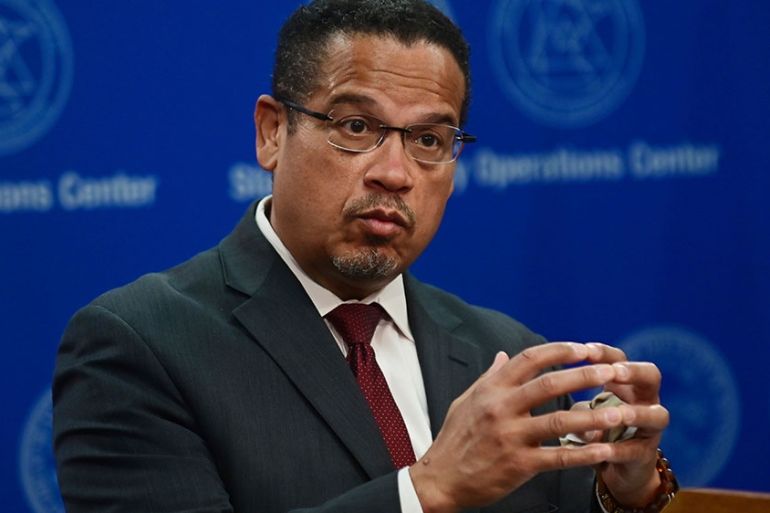 Minnesota Attorney General Keith Ellison answers questions during a 2020 news conference in St Paul, Minnesota [File: John Autey/Pioneer Press/AP]
Minnesota’s attorney general is suing the governor of Texas to force the extradition of a federal agent charged with shooting and wounding a man during President Donald Trump’s immigration crackdown in Minneapolis.
In a lawsuit filed on Tuesday, Minnesota Attorney General Keith Ellison argued that Texas Governor Greg Abbott has refused to fulfil his “mandatory” obligation to transfer Immigration and Customs Enforcement (ICE) agent Christian Castro, so that he may stand trial.
Recommended Stories
list of 4 itemsend of list“Governor Abbott has withheld the warrant and held up Castro’s extradition for nearly three months,” Ellison told reporters on Tuesday. “He has no discretion to decline to do so.”
Ellison also asked the US district court in southern Texas to bar Cameron County Sheriff Manuel Trevino from allowing Castro’s release from jail.
Castro’s case has become part of a national debate over transparency and excessive violence during Trump’s mass deportation campaign.
The agent was involved in the January 14 shooting of Julio Cesar Sosa-Celis, a Venezuelan man living in Minnesota. Officials allege that Castro fired a gun into Sosa-Celis’s front door, striking him in the leg.
Initially, the Trump administration said the agents had fired in self-defence, accusing Sosa-Celis and two other people of attacking officers with a broom and a snow shovel during an immigration enforcement operation.
Then-Homeland Security Secretary Kristi Noem went so far as to call the incident the “attempted murder” of an ICE agent.
But video emerged contradicting the ICE agents’ testimony, and in February, federal prosecutors dropped the charges they had filed against Sosa-Celis and his housemate, Alfredo Aljorna.
AdvertisementIn a statement that month, ICE’s then-Acting Director Todd Lyons confirmed that Castro and a second ICE agent appeared to have lied about the incident. The two officers were subsequently placed on administrative leave.
“A joint review by ICE and the Department of Justice (DOJ) of video evidence has revealed that sworn testimony provided by two separate officers appears to have made untruthful statements,” Lyons said in a statement at the time.
In May, the Hennepin County Attorney’s Office charged Castro with four counts of second-degree assault and one count of falsely reporting a crime.
“Mr Castro is an ICE agent. But his federal badge does not make him immune from state charges for his criminal conduct in Minnesota,” Hennepin County Attorney Mary Moriarty said in a statement.
Castro was arrested on May 29 in Texas, and he has remained in detention since.
But Ellison has expressed concern that Texas officials – including Abbott, an ally of President Trump – could seek Castro’s release rather than have him face trial.
The Minnesota attorney general described Castro as a flight risk, likely to flee across the US border to Mexico.
“We know that [Castro] has some connections to Mexico, and we know that he has some thought of at some point going to Mexico,” Ellison said. “So, we do believe he’s a risk.”
Abbott’s office told The Associated Press in a statement that it would not comment on “pending extradition matters”.
Under Texas law, Ellison said the 52-year-old Castro could be released from custody as soon as next week – 90 days after he was detained – if Abbott does not agree to his extradition.
The Sosa-Celis shooting was one of several cases this year that prompted questions about the use of deadly force during immigration proceedings.
The Minneapolis area was the subject of one of Trump’s most intense immigration enforcement campaigns, dubbed Operation Metro Surge.
Lasting from December to February, Operation Metro Surge saw what critics considered to be escalating tactics from immigration officials, including warrantless house searches.
Two US citizens, Renee Good and Alex Pretty, were killed by agents during protests against the operation.
Bolivia arrests political adviser to Latin American right-wingers
Bolivia arrests political adviser to Latin American right-wingers
The arrest comes after an attack on activist Nadia Beller, who says she was targeted for her opposition to conservative reforms and corruption.
Save
 Fernando Cerimedo has worked on political campaigns for Argentina's President Javier Milei, former Brazilian President Jair Bolsonaro, and Bolivia’s President Rodrigo Paz [File: Agustin Marcarian/Reuters]
Bolivia has arrested a prominent adviser to several right-wing political leaders in Latin America on suspicion of plotting a murder.
Fernando Cerimedo was arrested on Tuesday following an attack on lawyer and political activist Nadia Beller. The consultant has worked on political campaigns for Argentina’s President Javier Milei, former Brazilian President Jair Bolsonaro, and Bolivia’s President Rodrigo Paz.
The Argentinian national was arrested in Bolivia at an airport, trying to travel to his home country.
Security videos captured Beller standing in front of a hotel in Santa Cruz when two men dressed as delivery drivers walked up the stairs, shot her from close range, took some of her belongings, and left her behind as she lay on the ground.
Beller, who was four weeks pregnant, believes she was targeted for her opposition to a pack of unconstitutional laws under Decree 5503, which were being prepared by Cerimedo and the government, and for witnessing high-level corruption.
Decree 5503 introduces radical economic reforms, such as eliminating state fuel subsidies, that target policies put in place under Bolivia’s former socialist government.
Beller is also understood to have had a romantic relationship with Cerimedo. She admitted to her relationship with him in a video appearance from her hospital bed, and highlighted Cerimedo’s significant political influence.
She said she decided to speak out as she believes that “until I speak directly to the Bolivian people, they are going to finish what they attempted to do. They are going to end up taking my life”.
AdvertisementBolivian Vice President Edmand Lara said the attack “threatens life, democracy, and freedom of expression” in a news conference where he called for an impartial investigation “without any kind of favoritism”.
Trump administration moves to end rule protecting swaths of forest land
Trump administration moves to end rule protecting swaths of forest land
US Agriculture Department says rescinding the 2001 rule will help reduce wildfire risk and return control to local managers.
Save
 Downed trees in the Lincoln National Forest after last year's South Fork Fire in Alto, New Mexico, US, June 26, 2025 [Kaylee Greenlee/Reuters]
The United States Department of Agriculture (USDA) has filed a proposal to rescind the entirety of the 2001 Roadless Area Conservation Rule, which prohibits road construction and logging on nearly 45 million acres (18 million hectares) of national forest land.
Secretary of Agriculture Brooke Rollins submitted the proposal on Tuesday, saying it will mitigate wildfire risk by returning authority to local forest managers, who “know the land best”.
Recommended Stories
list of 4 itemsend of list“For too long, outdated restrictions have kept tens of millions of forested acres off-limits to the very treatments that improve forest health and reduce wildfire risk to our communities,” Rollins said in a statement. “It’s time to turn the page on the failed roadless rule and return our forests to health and productivity.”
The Trump administration and Republican lawmakers say building roads in these areas would make it easier for firefighters to access the land if a wildfire breaks out.
“For 25 years, the heavy thumb of Washington, D.C., has hindered Montana’s ability to properly manage wildfire risk and road development on nearly 60 percent of Forest Service land across the Treasure State,” Republican Governor Greg Gianforte of Montana said in a statement.
While the areas are referred to as “roadless”, there are thousands of miles of existing roads within the lands with federal, state, and county ownership. About half of these lands are within 1 mile (1.6km) of a road, and 31 percent are within 0.5 miles (800 metres) of a road, according to the National Forest Service.
AdvertisementThe USDA clarified that it is not forcing timber cutting or road construction.
But environmental groups say rescinding the conservation rule will open the door to developments that will increase the risk of wildfire. Fires are four times more likely to start near roads than in roadless forests, according to research from The Wilderness Society.
“Roadless forests are where wildlife live,” Taylor McKinnon, southwest director of the Center for Biological Diversity, said in a statement. “They’re home to jaguars, Mexican spotted owls, and ocelots, some of the most iconic animals on the continent. Plowing roads into their habitat will bring human-caused wildfires and disturbances that they don’t need and can’t afford.”
The US is experiencing one of its worst wildfire years in the last decade, with 7.3 million acres (3 million hectares) burned in about 49,000 fires through August 17, according to the National Interagency Fire Center.
More than 95 percent of the affected areas would be in 10 states: Alaska, Arizona, California, Montana, Nevada, New Mexico, Oregon, Utah, Washington, and Wyoming.
In early August, the state of Washington fought a highly destructive wildfire that burned more than 8,000 acres (3,200 hectares) and forced approximately 65,000 people to evacuate.
Last month, the Trump administration finalised rollbacks of two regulations affecting the Endangered Species Act. One change requires officials to weigh economic and national security considerations when determining whether an area should be designated as “critical habitat”.
The public will have until September 21 to comment on the proposed Roadless Rule.
Why is the US ramping up Tomahawk production?
Inside Story
Why is the US ramping up Tomahawk production?
The Pentagon has contracted a defence manufacturer to increase the output of cruise missiles.
It’s a multibillion-dollar deal that some military analysts say confirms suspicions that the United States is running out of critical munitions.
The Pentagon has contracted defence company Raytheon to significantly increase its output of Tomahawk missiles.
Recommended Stories
list of 3 itemsend of listRaytheon has supplied the US with weapons for decades, but this time is different.
The company is set to deliver the Tomahawks at an unprecedented scale and speed.
How important are these missiles to US defence strategy?
And could this ignite a global arms race – and lead to more conflict?
Presenter: Anna Burns-Francis
Guests:
David Des Roches – professor at the Thayer Marshall Institute and former Pentagon director for Arabian Peninsula affairs
Patrick Bury – defence and security specialist at the University of Bath and a former NATO analyst
Dan Grazier – senior fellow and director of the National Security Reform Program at the Stimson Center
Save
Syria opens Assad-era nuclear programme to UN probe
Syria opens Assad-era nuclear programme to UN probe
UN watchdog reports that it found large amounts of material at undisclosed sites in Syria.
Save
 Syrian Foreign Minister Asaad al-Shaibani at a meeting with the International Atomic Energy Agency (IAEA) chief in Damascus [SANA/Handout via AFP]
Syria has opened the way for the United Nations to probe the remains of a nuclear programme operated by ousted leader Bashar al-Assad.
Syria’s government said on Tuesday that it was working with the International Atomic Energy Agency (IAEA) as the UN watchdog reported it had found several tonnes of nuclear material at a site in Damascus.
Recommended Stories
list of 3 itemsend of listSyria had reported the site to the IAEA last month. The material found was not dangerous and will remain in Syrian custody, subject to guarantees, Foreign Minister Asaad al-Shaibani said.
Since the fall of the Assad regime in late 2024, Syria’s authorities have committed to working with the IAEA to address the legacy of nuclear activities carried out during the decades of Assad family rule.
The IAEA inspectors visited two sites, one in Deir ez-Zur and “a second location related to the nuclear material identified by Syria recently”, according to a joint statement.
Speaking at a news conference in Damascus, IAEA chief Rafael Grossi praised the government’s “courageous decision” to report the undisclosed site.
“We are talking about a few tonnes of nuclear material that could be put to bad use,” he said, promising that it would be placed under international safeguards.
Foreign Minister al-Shaibani said: “On July 17, we sent an official letter to the agency, in which we declared of our own free will the presence of nuclear materials at an undeclared site within the legacy left by the former regime.”
Syria is not known to hold operational stockpiles of nuclear material for a weapons programme, but Israel bombed a suspected Syrian nuclear reactor in 2007 in Deir ez-Zur.
AdvertisementCongo Ebola outbreak ‘global emergency’ as infections pass 5,000: WHO
DR Congo’s Ebola outbreak ‘global emergency’ as infections pass 5,000: WHO
Officials warn that they are continuing to identify new chains of transmission that need to be broken to stop the spread.
Save
 The outbreak is now the country's deadliest, with more than 2,320 people having died [File: AFP]
The Ebola outbreak in the Democratic Republic of the Congo (DRC) remains a global health emergency, the World Health Organization (WHO) has warned, saying that the number of cases in the country has passed 5,000.
Following an emergency meeting on Tuesday, WHO Director-General Tedros Adhanom Ghebreyesus called on the international community to assist in efforts to contain the outbreak, which has killed more than 2,320 people.
Recommended Stories
list of 3 itemsend of list“We must be frank: The epidemic is far from being under control,” Tedros told the emergency meeting. “It had a big head start, and we are still playing catch-up.”
The outbreak is the seventeenth in the DRC and is now the deadliest, exceeding the number of people killed during the 2018 to 2020 outbreak – 2,299.
The emergency has caused more concern than usual for several reasons, including the fact that there is currently no approved vaccine or treatment for this strain of Ebola, known as Bundibugyo.
Response efforts have been further complicated by conflict in the mineral-rich DRC, as well as misinformation, distrust of health workers, and cultural traditions, among other factors.
Tedros warned on Tuesday that the outbreak was spreading at an “unprecedented speed” and that the locations of many of the deaths show there are chains of transmission yet to be identified.
The epidemic will continue until every chain is found and broken, he warned.
WHO medic Thierno Balde told reporters that motorbike riders are now a core focus of response efforts due to their transport duties, including delivering patients and dead bodies.
Advertisement“Hand-washing stations and disinfectant have been made available, but the new objective is to recruit them as surveillance and response officers,” Dr Balde added, as the organisation makes a major push to increase community engagement in tackling the disease.
The outbreak was declared on May 17, but genetic sequencing of samples shows that it began spreading three months earlier, in February.
The first volunteer to receive an experimental vaccine for this strain of Ebola received his jab in the United Kingdom last month. Hundreds of thousands of doses of the vaccine, produced by scientists at Oxford University, have already been manufactured in India and are ready for immediate use if the trials are successful.
Trump says no talks planned with Iran amid anger over Iran-Oman Hormuz deal
Trump says no talks planned with Iran amid anger over Iran-Oman Hormuz deal
US president hits out as states bordering the Strait of Hormuz continue talks on managing the strategic waterway.
Save
 US President Donald Trump's comments represent his latest about-turn: Just a day earlier, he had claimed that the US was engaged in back-channel conversations with Iran's Islamic Revolutionary Guard Corps (IRGC) [File: AFP]
President Donald Trump has asserted that the United States is not engaged in talks with Iran and has not scheduled any, but has meanwhile insisted that the Strait of Hormuz remains open.
The US leader insisted in a social media post on Tuesday that while the naval blockade of Iranian ports remains “in full force and effect”, all other marine traffic was free to pass. He also posted a map depicting the strategic waterway as US territory.
Recommended Stories
list of 4 itemsend of listThe comments represent Trump’s latest about-face. On Monday, he had claimed that the US was engaged in back-channel conversations with Iran’s Islamic Revolutionary Guard Corps (IRGC). Tehran was quick to reject that claim.
Tuesday’s remarks appear to reflect Trump’s frustration, as Iran and Oman, countries that border Hormuz, continue talks on managing the strait, despite the US president’s demand for Iran to surrender and his threat to bomb Oman should it interfere in the issue.
“There are no talks or conversations going on, or scheduled, with the Islamic Republic of Iran. The Naval Blockade remains in full force and effect. The Hormuz Strait is open and operating. All water mines have been removed or detonated,” Trump posted.
Iran has reiterated that Hormuz would remain closed until Washington met the terms of the pair’s memorandum of understanding (MoU) that was signed in June with the aim of ending the hostilities that began in March.
Kazem Gharibabadi, Iran’s deputy foreign minister for legal and international affairs, appeared to respond to Trump’s post.
Advertisement“Just as Trump correctly wrote the name of the eternal Persian Gulf, soon his delusion regarding the Strait of Hormuz will either be corrected or we will correct the delusions of this deluded man,” Gharibabadi wrote on social media.
Meanwhile, mediators continue to try to revive negotiations. Qatar said on Tuesday that mediators are awaiting the expected Iran-Oman deal before pushing Washington and Tehran to resume talks.
A US official told Al Jazeera that “positive talks” with Iran have been ongoing, but that Trump has now “decided to wait” and instructed his negotiating team to hold off until Tehran is “ready to make a deal”.
There is “no conflict” in the US administration’s position regarding talks with Iran, the official insisted.
Apparently reflecting his latest change of tack, the US president posted an image on his Truth Social platform showing a map of the Strait of Hormuz captioned “New US Territory”, a repetition of his threat last week to declare the strait as such after Iran’s “surrender”.
Top Iranian negotiator Mohammad Bagher Ghalibaf, meanwhile, said in comments published by state media on Tuesday that the Strait would remain shut until the US met the conditions of the MoU.
Those conditions include the US lifting its blockade of Iranian ports, lifting oil sanctions, releasing Tehran’s frozen assets, and ending threats and military operations on all fronts, Ghalibaf told parliament.
Regional strikes continue
The rhetoric emerging on both sides illustrates that outward progress towards peace talks and the return of maritime traffic through Hormuz has ground to a halt, threatening to extend the conflict.
To that end, a missile threat alert was issued by the United Arab Emirates on Tuesday evening, as the country’s Defence Ministry said its air defences “detected two ballistic missiles launched from Iran”. Both projectiles were reported to have landed in the sea.
The ministry added that it was on high alert and “fully prepared” to deal with any threats, it said in a statement published on X.
Earlier on Tuesday, eight air strikes hit the Abu al-Duhur military base in Idlib’s eastern countryside, causing damage and no casualties, Syrian state media reported.
States including the US have accused Israel of launching the strikes. US special envoy for Syria and Iraq Tom Barrack said it was “an unnecessary escalation that does not advance regional stability”.
Israeli strike reported to kill at least six in Gaza City
Israeli strike reported to kill at least six in Gaza City
The strike comes as efforts to push an agreement aimed at ending hostilities remain stalled.
Save
 Paramedics carry the body of a person killed in an Israeli strike on August 18, 2026 in Gaza City, Gaza [Ahmad Hasaballah/Getty Images]By Al Jazeera StaffPublished On 18 Aug 202618 Aug 2026
An Israeli strike has killed at least six people in Gaza City as an agreement aimed at ending hostilities remains stalled.
Officials at al-Shifa Hospital said they had received several bodies following the attack on Tuesday. Fourteen others were injured when the strike hit a crowded cafe in the city’s port, which has been turned into a displacement camp, according to Palestinian reports.
Recommended Stories
list of 3 itemsend of listThe attack comes as Israeli Prime Minister Benjamin Netanyahu continues to reject the United States-backed plan to end the hostilities in the enclave.
Facing down his key ally, Netanyahu continues to insist that the Israeli military will not withdraw from Gaza unless Hamas agrees to disarm first.
The Palestinian group insists that it will only give up its weapons once Israel withdraws its soldiers. The Israeli military currently occupies about 60 percent of the enclave.
The Israeli army said it was targeting a gathering of several Hamas commanders who were planning attacks, but has not provided any evidence.
Hamas issued a statement following Tuesday’s attack, denouncing it as a “blatant disregard for all calls for a ceasefire issued by mediators and guarantor states”.
Footage shared on social media shows several Palestinians lying on blood-stained ground, as witnesses hurry the injured to ambulances waiting nearby.
Reporting from Gaza City, Al Jazeera’s Hani Mahmoud said the attack took place as many people in the seaport came out of their tents to escape the extreme heat.
“These attacks happen in an unpredictable way. You could be walking in the street; you could be sitting in a cafe when such attacks happen because there are no prior warnings,” he reported.
AdvertisementThe strike came a day after President Donald Trump’s son-in-law and envoy Jared Kushner concluded an unsuccessful visit to the region aimed at advancing Washington’s 15-point peace plan. Both Hamas and Netanyahu refused to budge on their demands following meetings with the envoy.
Netanyahu is seeking another term as prime minister in upcoming elections, which are due to be held in October. It is widely expected that he will continue to refuse Trump’s peace plan until at least after the vote to avoid harming his electoral prospects, as his ruling coalition continues to trail in opinion polls.
WHO: Ebola can be contained in months if enough funding is provided
US Justice Department denies whistleblower claims on anti-Semitism probes
US Justice Department denies whistleblower claims on anti-Semitism probes
Ivy League schools were pressured into settlements despite a lack of evidence, according to former DOJ lawyer.
Save
 A drone view shows an encampment at Harvard University where students protest in support of Palestinians on April 25, 2024 [Brian Snyder/Reuters]
A whistleblower alleges that United States President Donald Trump’s administration’s findings that three of the country’s most prestigious academic institutions violated civil rights law by tolerating anti-Semitism were “predetermined” as part of a “politically mandated effort” that allegedly discarded standard investigative procedures.
The administration has now pushed back, disputing the whistleblower’s involvement in the investigations.
Recommended Stories
list of 3 itemsend of listA spokesperson for the Department of Justice (DOJ) has told Al Jazeera that former DOJ lawyer Haley Van Erem, whose lawyers submitted the complaint, “did not work on university investigations” during her tenure at the department.
Van Erem filed the complaint with the inspectors general at the Departments of Justice and Health and Human Services and the Office of Special Counsel. The civil rights lawyer spent nearly a decade working in the Justice Department’s Civil Rights Division before being involuntarily assigned to help with the task force last year, according to the disclosure. She ended up vacating her role at the DOJ in May 2025 because she was “unwilling to be made vulnerable to further participation in politically motivated investigations unsupported by facts and contrary to law”, according to the complaint, which also accuses the task force of targeting Muslim professors.
The complaint, obtained and reported on by The Associated Press news agency, also alleges that Trump’s Joint Task Force to Combat Anti-Semitism pushed for multimillion-dollar settlements with Ivy League universities despite government investigations that failed to establish any legal wrongdoing by the universities. The disclosure described political appointees overruling career investigators and targeting professors based on religion and ethnicity.
AdvertisementThe work of the multi-agency task force was “marked by extraordinary procedural irregularities, predetermined outcomes without factual or legal support” and a slight to the law and Constitution, lawyers for the former government lawyer wrote in seeking watchdog investigations into their client’s allegations.
The task force, launched by the Justice Department under then-Attorney General Pam Bondi in February 2025, was created by Trump via an executive order to root out what the administration said was extensive “antisemitic harassment in schools and on college campuses” following protests that broke out at institutions across the country as Israel waged its genocidal war in Gaza.
The complaint alleges that the investigations into the Ivy League schools were pursued to strong-arm them into striking deals for politically motivated reasons, and that the outcome of the investigations was preordained with the purpose of extracting money from schools through settlement demands and funding freezes under the pretext of rooting out anti-Semitism.
The DOJ spokesperson said they “stand behind the integrity of these investigations”.
Representative Jamie Raskin, ranking member of the House Judiciary Committee, has launched an investigation into the explosive whistleblower allegations that the Trump administration’s political appointees “grossly manipulated” federal anti-Semitism investigations to target certain American universities, punish protected speech and force schools into settlements despite government investigators finding insufficient evidence to verify any Title VI violations.
“From the start of the Trump Administration’s ferocious attack on universities, it has been apparent that its investigations have been structured deliberately to harass and intimidate rather than protect anyone from discrimination,” wrote Raskin in a press release on Tuesday.
“Your ‘investigation’ into antisemitism was fake, a pre-baked frame-up operation thoroughly political in nature,” wrote Raskin separately, in a letter addressed to Harmeet Dhillon, who, as the assistant attorney general in charge of the DOJ’s Civil Rights Division, had been a public face of the department’s efforts to counter anti-Semitism.
Raskin did not respond to Al Jazeera’s request for comment at the time of writing.
Both Brown and Columbia settled with the administration. Columbia agreed to pay $200m over three years, and Brown agreed to spend $50m on Rhode Island workforce development, even though the task force found no formal admission of university misconduct.
AdvertisementA federal judge last year ordered the Trump administration to reverse its cuts of more than $2.6bn in research funding for Harvard, saying the government “used antisemitism as a smokescreen for a targeted, ideologically-motivated assault on this country’s premier universities”. A different judge last week dismissed a Trump administration lawsuit that accused Harvard of turning a blind eye to harassment of Jewish students.
Turkish politician Melih Meric stabbed