Trump rescinds EPA’s ability to regulate greenhouse gases. What’s the impact?
President Donald Trump and Environmental Protection Agency Administrator Lee Zeldin on Thursday ushered in a new era of climate regulation, effectively rescinding a 16-year-old foundation for federal policies to reduce emissions of heat-trapping gases such as carbon dioxide.
The White House says the move will unshackle a needlessly regulated energy sector, though many climate scientists see the step as undercutting action on an urgent priority for the United States and the world.
Since 2009, what’s known as an “endangerment finding” by the EPA has classified greenhouse gases (GHGs) as a threat to public health. In turn, that designation has served as a legal basis for emissions regulations. In undoing it, Trump administration officials argue the endangerment finding stood on shaky legal ground.
Why We Wrote This
President Donald Trump and his team held a “Clean, Beautiful Coal” event this week and are rescinding a rule that enables the EPA to regulate greenhouse gases. But the moves come as renewable energy sources including solar are increasingly in demand.
Opponents of Thursday’s action will appeal, and courts will ultimately play a key role in deciding. Both sides agree the stakes are high.
“It has the broadest impact on EPA’s legal authority, this agency that literally has one job, to protect human health and the environment,” says Meredith Hankins, the federal climate legal director at the Natural Resources Defense Council, an international environmental advocacy group. “They are just walking away from that responsibility.”
Mr. Zeldin, in announcing the reversal, said “The Trump EPA is strictly following the letter of the law, returning common sense to policy, delivering consumer choice to Americans and advancing the American dream.”
Unless blocked in court, the move represents the most aggressive rejection of climate change policies by the Trump administration thus far. It also comes as renewable energy sources are increasingly competitive in price – and popular even among Trump voters – compared with coal and other fossil-fuel energy sources.
Recent polls show strong Republican support (61% in a Pew Research Center survey) for solar energy farms, alongside other energy sources, amid concerns about high electricity costs. The economy has been continuing to move away from fossil fuels, with GHG’s declining by about 1% a year since 2007, according to the Rhodium Group. The Trump policy changes, while not erasing that trend, may slow it considerably.
The administration sees the rollback as a boost to the economy, saying the endangerment finding is “unnecessarily expensive.” Cars are one key sector that will be affected, because the finding served as the legal foundation for regulating vehicle greenhouse emissions under the Clean Air Act.
 Jonathan Ernst/Reuters
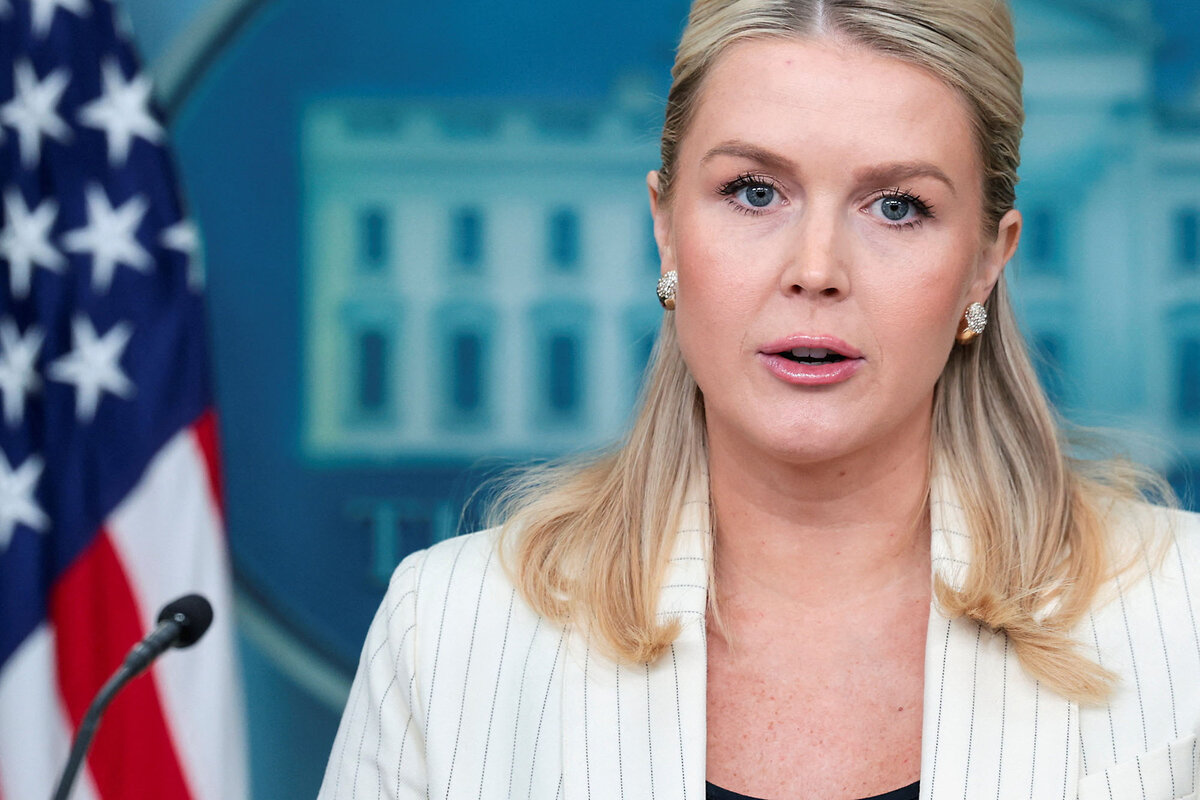
The decision, White House press secretary Karoline Leavitt said at a news briefing this week, will save the American people $1.3 trillion in “crushing regulations.” She also said the savings would include reduced costs for new vehicles of around $2,400 for “popular light duty cars, SUVs, and trucks.”
The endangerment finding is also the foundation for regulating coal and gas power plants and the methane levels produced by both the oil and gas industries.
Thursday’s rollback comes a day after President Trump, Mr. Zeldin, Energy Secretary Chris Wright, and Interior Secretary Doug Burgum met at the White House, where Mr. Trump hosted a “Clean Beautiful Coal” event, casting the coal industry as pivotal to U.S. energy production going forward.
Mr. Trump signed an executive order directing the Defense Department to prioritize long-term, on-demand power purchases with coal-based power plants for future military installations.
Efforts that unraveled the endangerment finding
Last July, the Heritage Foundation released a policymaker memo titled “Reversing the EPA’s Endangerment Findings on Greenhouse Gases.” Authors Kevin Dayaratna and Diana Furchtgott-Roth argued that it is inconclusive whether GHGs harm human health.
“The critical question is whether [carbon dioxide], a component of the ambient air, which is crucial for life on Earth, can be considered ‘air pollution,’” the report’s analysis reads. “The answer is ‘No.’ The Clean Air Act was not designed for the regulation of such essential components of the air that humans and animals breathe.”
The backing for the Trump administration’s argument supporting the reversal of the endangerment finding comes from an Energy Department report, “A Critical Review of Impacts of Greenhouse Gas Emissions on the U.S. Climate,” which has been used to justify diminishing the credibility of the rules precedent.
The overwhelming scientific consensus is that climate change is occurring, is the result of human activity, and poses severe risks for ecosystems and the human economy. The Trump administration’s report reflects the conclusions drawn last summer by a working group of scientists outside that consensus, formed by Energy Secretary Wright. Group members John Christy, Judith Curry, Steven Koonin, Ross McKitrick, and Roy Spencer held closed-door meetings to produce their sweeping report.
The EPA’s rationale for striking down the endangerment finding is based on the report’s suggestion that GHG regulations have minimal climate impact.
“The report was harshly criticized by many scientists, including the National Academy of Sciences, which put together a very detailed report that basically showed the Department of Energy report was completely wrong,” says Michael Gerrard, an environmental law professor at Columbia University.
 Rod Lamkey, Jr./AP/File
On Jan. 30, U.S. District Judge William G. Young of Massachusetts ruled that the panel’s meeting was illegally convened, violating the 1972 Federal Advisory Committee Act’s transparency requirements. The panel violated the act, the judge ruled, by not opening its meetings to the public.
Judge Young, first appointed in 1985 by President Ronald Reagan, declared: “These violations are now established as a matter of law.”
What’s next for climate regulation?
The rescission of the endangered finding is expected to wipe clean most U.S. policies geared toward reducing emissions, starting with emissions standards for trucks and cars.
States, environmental groups, and industry stakeholders are expected to appeal in court against the administration’s move. The pathway for challenging the repeal starts with the U.S. Court of Appeals for the District of Columbia, and could make its way to the Supreme Court – a process that could take years.
Deepen your worldview
with Monitor Highlights.
Already a subscriber? Log in to hide ads.
The EPA’s endangerment finding had its legal roots in a 2007 U.S. Supreme Court ruling, Massachusetts v. EPA. The court has become more conservative in the intervening years, setting up a potential swing against the tenor of its prior ruling, Professor Gerrard says.
If the issue reaches the Supreme Court, oral arguments might be influenced by the 2022 decision in West Virginia v. EPA, which established that, under what legal scholars call the “major questions doctrine,” the EPA’s authority to control emissions is limited. The ruling holds Congress, not agencies, responsible for making major policy decisions. Professor Gerrard says that if the case is won on those grounds, it could hinder a future president from reversing the current administration’s action – unless Congress provides that authority.