How a legal battle in Minnesota could affect refugees
The Trump administration is advocating in court for a novel interpretation of U.S. law in order to arrest and detain refugees in Minnesota, challenging decades of bipartisan policy on refugee treatment.
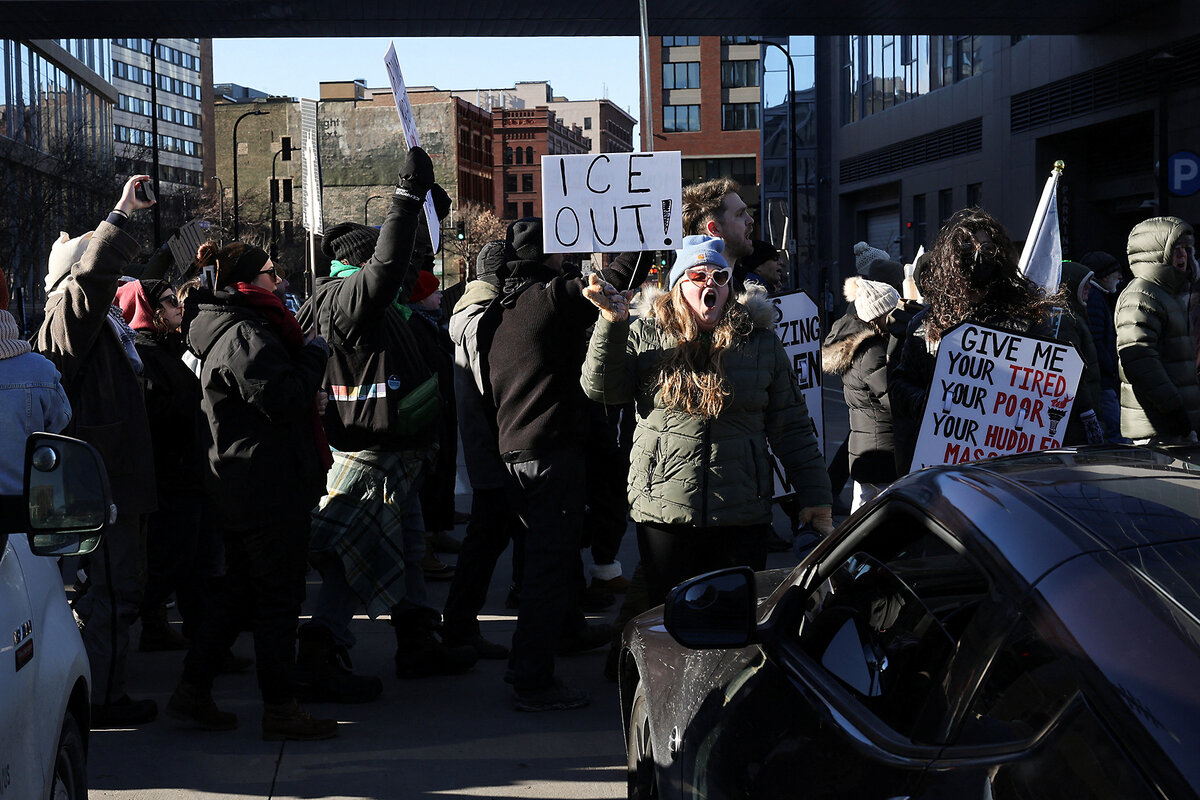
Over 100 refugees in Minnesota have been arrested and interrogated by immigration officers in recent weeks, according to immigration advocates in a complaint. In a separate court filing, an Immigration and Customs Enforcement official put the number of people detained in the operation at 72.
Arrests of vetted, lawfully admitted refugees depart from President Donald Trump’s pledge to target those in the United States illegally and with criminal records. But the arrests align with other administration goals, including to reverse former President Joe Biden’s immigration policies and scrutinize people he let in.
Why We Wrote This
Refugees in Minnesota are challenging the Trump administration over its arrest and detention tactics. The case features an unprecedented legal argument that could reshape federal-local immigration cooperation.
Border Patrol encounters, a proxy for illegal crossings, hit a record high under President Biden. Refugee admissions, which are lawful entries, also reached a 30-year high during the Biden administration, which sought to boost refugee numbers to address what it called a growing global humanitarian crisis.
On Jan. 9, the Department of Homeland Security announced the launch of Operation PARRIS in Minnesota, calling it a “sweeping initiative reexamining thousands of refugee cases.”
The effort drew less attention than the administration’s Operation Metro Surge, announced just a month before. At its peak, that operation brought around 3,000 federal agents to the Twin Cities to crack down on illegal immigration and resulted in the deaths of two U.S. citizens. Both operations started amid a swirl of media attention that spotlighted fraud cases involving Minnesotans of Somali descent. Minnesota has a long history of welcoming immigrants and refugees from around the world.
While Trump administration border czar Tom Homan announced the end of Operation Metro Surge last week, the timing and extent of the withdrawal remain unclear.
The future of the refugee-focused operation in Minnesota, however, is now heating up in court.
U.S. District Court Judge John Tunheim issued a temporary restraining order in late January prohibiting immigration enforcement authorities from arresting or detaining refugees in Minnesota. The order also compelled the release of those detained.
On Feb. 9, Judge Tunheim denied the government’s request to dissolve that temporary order and reiterated that the Trump administration’s legal rationale for arresting refugees in Minnesota is unlikely to succeed. The judge has noted the government appears to be relying on an unprecedented interpretation of immigration law.
Judge Tunheim will hold a hearing Thursday to consider a preliminary injunction in the case, which could replace the temporary restraining order.
What is happening to refugees in Minnesota?
Refugees undergo extensive vetting before being admitted to the U.S. They must demonstrate they have been persecuted – or have a well-founded fear of persecution – based on their identity. The Trump administration and its supporters have warned that refugees from countries hostile to the U.S. could pose national security threats.
When Operation PARRIS launched, immigration authorities announced they were initially focused on 5,600 refugees in Minnesota who had not yet attained green cards. A federal class-action lawsuit has meanwhile been filed by a group of Minnesota refugees and the nonprofit Advocates for Human Rights to stop arrests and detentions that they allege are without warrants or probable cause.
 Go Nakamura/Reuters
In court documents, plaintiffs described what they say happened to several refugees, identified by their initials. “D. Doe,” for example, was at home on Jan. 11 when a man in plain clothes knocked at his door and told him he’d hit his car, the complaint says.
When D. Doe went to look, according to the document, he was “surrounded by armed men” and handcuffed, then taken to a detention center in Minnesota and flown to Texas, where he was later released on the street. In a separate court filing, Tauria Rich, ICE’s deputy field office director in St. Paul, said detainees were sent across the country due to the “lack of available bedspace in Minnesota,” which she blamed on state obstruction.
Another refugee, referred to as “U.H.A.”, was driving to work when DHS officers stopped him, ordered him out of his car, and then handcuffed and detained him, without apparent justification, the complaint alleges.
Marc Prokosch, an immigration lawyer in the Twin Cities area, said last month that he had started prewriting habeas corpus petitions for refugee clients who might be detained. That way, he could challenge their arrest in federal court in Minnesota before his clients were flown out of state.
Since early January, the International Institute of Minnesota has tracked 12 refugee clients without green cards who have been arrested under Operation PARRIS. Some have since been approved for green cards, and all have been released, according to the nonprofit. All came to the U.S. during the Biden administration.
Jane Graupman, the institute’s executive director, says she has never seen anything like this in her more than three decades with the institute.
“Refugees have just left persecution in their own country,” she says. “It is very heartbreaking to see them living in such fear now in this country.”
Beyond the arrests, which advocates say have halted, refugees in Minnesota have received notices from U.S. Citizenship and Immigration Services to appear for in-person interviews at that agency’s St. Paul field office. At least some of these “call-in letters,” reviewed by the Monitor, say to bring any spouse or children over age 14 who were admitted along with the main applicant.
Representatives from the organizations World Relief and International Refugee Assistance Project say the interviews can last three to eight hours. They also say refugees are still afraid to leave their homes, despite a lower risk of detention.
What is the Trump administration’s argument?
The government points to immigration law to defend its actions.
After a refugee’s first year here, immigration law requires them to apply for a green card, also known as lawful permanent resident status. The law says after that year, the refugee shall “return or be returned to the custody of the Department of Homeland Security for inspection and examination for admission to the United States.”
The word “custody” is key. The Trump administration is interpreting “custody” to mean refugees should be physically detained. Immigration advocates say this reading is new and overlooks the review process already in place as refugees apply for green cards.
 Julia Demaree Nikhinson/AP/File
How has the court weighed in so far?
In his Jan. 28 order, Judge Tunheim said the government’s interpretation of “custody” in the statute is unlikely to succeed in court.
“At its best, America serves as a haven of individual liberties in a world too often full of tyranny and cruelty,” he wrote. “We abandon that ideal when we subject our neighbors to fear and chaos.”
The judge also noted that the order does not impact the “lawful enforcement of immigration laws” by the Department of Homeland Security. DHS includes USCIS, the agency that oversees lawful immigration, and Operation PARRIS.
“The swift reinterpretation of long-held and consistently understood applications of the law raises serious constitutional questions,” Judge Tunheim wrote in his Feb. 9 order.
How has the government responded?
USCIS defends Operation PARRIS as necessary to tackle fraud, and says it’s being stymied by an “activist order.” Judge Tunheim was appointed to the bench by former Democratic President Bill Clinton in 1995.
“This operation in Minnesota demonstrates that the Trump administration will not stand idly by as the U.S. immigration system is weaponized by those seeking to defraud the American people,” said Matthew Tragesser, a USCIS spokesperson, in a statement. It’s unclear to what extent, since arresting the refugees, the PARRIS effort has uncovered suspected fraud.
The court loss is “yet another lawless and activist order from the federal judiciary who continues to undermine our immigration laws,” said Mr. Tragesser. “We look forward to being vindicated in court. American citizens and the rule of law come first, always.”
USCIS declined an interview request and did not directly address several questions sent by the Monitor.
A novel reading of the law doesn’t make it incorrect, says Andrew Arthur, resident fellow in law and policy at the Center for Immigration Studies, a think tank that advocates for low immigration.
“The way that we’ve just always done things in immigration … doesn’t always comport with the language of the statute,” says Mr. Arthur, who served as associate general counsel at the former U.S. Immigration and Naturalization Service. “The ultimate interpretation of the law rests with the judiciary.”
How does all of this fit with broader policies on refugees?
The Trump administration’s refugee arrests align with broader efforts to strip lawfully present immigrants of deportation protections and tighten scrutiny of others who wish to remain.
After federal officials accused an Afghan national of the fatal shooting of a National Guard member and the wounding of another in November, USCIS announced stricter vetting for nationals of several countries and paused all asylum decisions outside of immigration court. The suspect did not enter the U.S. as a refugee.
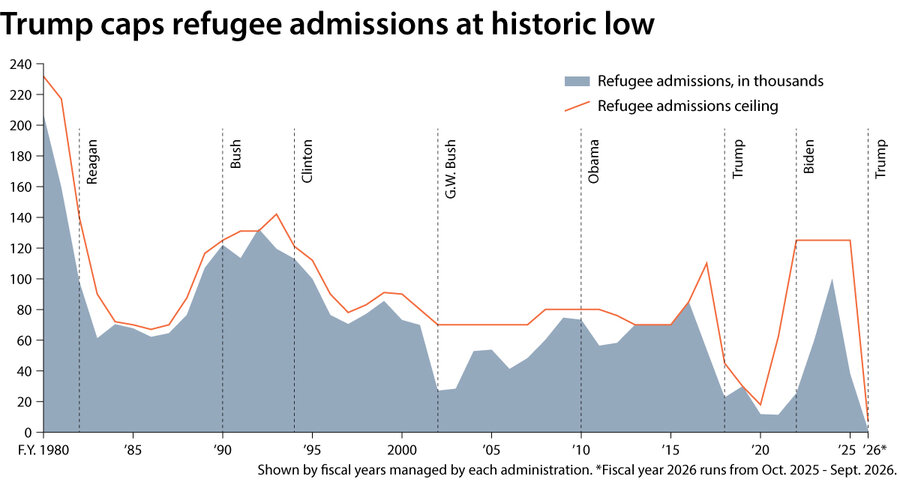
This fiscal year, Mr. Trump has set a cap on refugee admissions at 7,500 – the lowest since Congress created the program in 1980. Refugee admissions reached over 100,000 under Mr. Biden in fiscal 2024, his last full year in office, a 30-year high.
 SOURCE:
Bureau of Population, Refugees, and Migration; Migration Policy Institute
Under President Biden, the largest numbers of refugees came from Africa and the Middle East, with a significant increase in arrivals from Latin America.
Now, Mr. Trump is prioritizing the admission of Afrikaners, who are white South Africans, after suspending the U.S. Refugee Admissions Program on his first day back in office. Between October 2025 and the end of January, the administration admitted three refugees from Afghanistan and 1,648 from South Africa, according to State Department data.