The evolution of Lincoln’s immigration ideals: A historian assesses his legacy
Abraham Lincoln faced a nation divided, and not just by the Civil War.
A national battle over immigration had already raged for decades as millions of Europeans arrived.
The Republican president might be best known for his emancipation mission, but he also saw immigration as key to keeping the country afloat with so many men off at war. Hundreds of thousands of German, Irish, and other foreign-born soldiers also helped the Union Army win.
Why We Wrote This
The United States’ current debate over immigration is only the latest episode in the country’s history. President Abraham Lincoln – best known for the abolition of slavery – had a mixed record on immigration but championed newcomers’ “right to rise.”
Still, Lincoln’s immigration record is mixed. He signed legislation in 1862 that limited Chinese labor. But Lincoln also championed a law that reduced barriers to immigration – the last such law for a century. His Homestead Act offered land out West to U.S. citizens and future citizens as well – though at the cost of more Native American displacement.
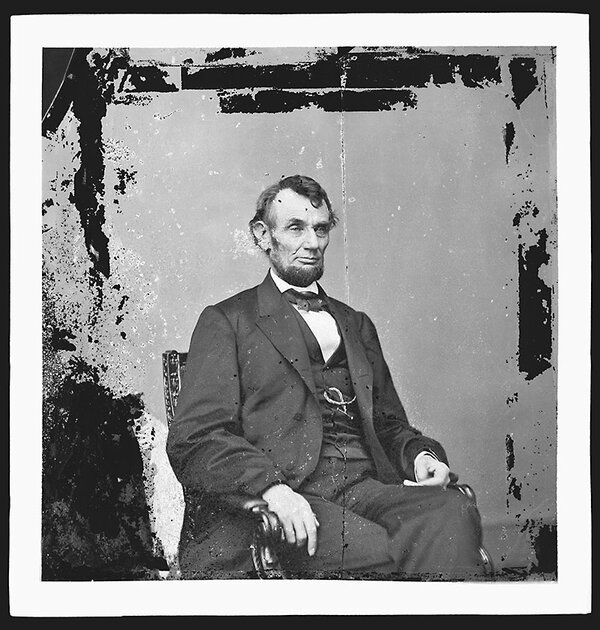 Library of Congress
More broadly, the president believed that anyone with talent, ambition, and a willingness to work “had the right to go as far as the American experiment allowed you to go,” says Harold Holzer, author of “Brought Forth on This Continent: Abraham Lincoln and American Immigration.”
As the American debate over who belongs here continues to roil, the Monitor explored Lincoln’s immigration legacy with Mr. Holzer, the director of the Roosevelt House Public Policy Institute at Hunter College and Manhattan’s new borough historian. Our conversation was edited for clarity and length.
How did the Lincoln-era debate over who to let in compare to the immigration debate now?
America always seems to be embroiled in the question of who should enter the country. Who should be encouraged, or who should be discouraged, or who should be banned, or who should be deported. It’s been going on for centuries, ever since the founding of the republic.
If you look today at the responses that we hear from certain anti-immigration forces about endangering Americans – creating a separate culture, replacing us, the fear of being replaced – all of that has been heard before.
It happened when the Irish started coming in the 1840s, and then the German Protestants in the late 1840s. ... Then in the 1890s, when Eastern and Southern Europeans came, and Jews came, there was exactly the same kind of resistance and fear. Same with the anti-Asian immigration laws.
Early in his political career, Lincoln, along with other Whigs, accused Democrats of coaxing ineligible Irish immigrants to vote for their cause. How much merit did those voter fraud claims have then?
As little merit as they have today. Were there occasional incidents? I’m sure there were. And Lincoln himself fell into this kind of ugly trope during the election ... for Senate in 1858. We have a letter from him, in which he reports to his campaign colleagues that he saw “about 15 Celtic gentlemen” ... who had just arrived in the city, and maybe detectives should be hired to see if they were coming here to vote illegally.
On the other hand, even earlier than that, he was in favor of noncitizen immigrants voting in municipal elections. Because he felt that they were being taxed with services, and participated in the municipal culture, and therefore should have responsibilities and obligations and rights.
I wonder if you can talk about the evolution of Lincoln’s support for immigrants and how that related to his antislavery work.
There was a relationship.
He identifies early with the Whig Party. [It included] a lot of Easterners who are anti-immigration as part of the Whig big tent, I guess. And the reason for it is that immigrants’ first port of call in the United States were the Eastern cities: Boston, New York, Philadelphia. And that’s where nativism first reared its ugly head, because most of the Irish arrivals joined the Democratic Party almost as soon as they arrived, for good reason. The Democrats courted them. The Democrats reached out to them and promised them guidance in establishing themselves in the city.
So, Lincoln and the Whigs were suspicious of these new Democrats, anyone who was added to the Democratic ranks. But early on, there was a riot in Philadelphia, an anti-nativist riot, a really ugly one, with casualties. ... And Lincoln and other Whigs quickly disassociated themselves from mob violence and stressed that there had to be a recognized, universal system of accepting immigrants and adding them to citizenship.
 Matt Capowski
It’s important to know, by the way, how easy it was to become a citizen. ... In those days, you came into the country, there were no walls, no [Immigration and Customs Enforcement], no discouragement. America wanted people, needed people. Aside from this prejudicial resistance, they simply entered. They signed some papers. Five years later they could return and apply for citizenship and earn voting rights.
As far as the kinship to the antislavery movement: When nativism became a big force in American politics, it evolved into a real political party known as the American Party, or more informally as the Know-Nothing Party. They ran a presidential candidate in 1856, who did very well. They elected a governor of Massachusetts. They elected public officials in Illinois. They were a force to be reckoned with. And Lincoln, at this time, was helping to organize the brand-new, antislavery Republican Party. And he needed the biggest tent he could open to swell the ranks of this brand-new organization. So Whigs, who no longer had a party, were encouraged into the new Republican Party.
He let the word out that if there were antislavery forces within the Know-Nothing movement, and there were, they would be welcome to join the Republican Party as well. So, at the same time he was creating an antislavery coalition, he was not shutting off the nativists for their past sins.
How much did merit – versus humanitarian concerns – factor into Lincoln’s immigration ideals?
I don’t think it was a merit-based system, because most of the people coming in were entry-level positions.
Yes, there were indentures. There were all sorts of difficulties. But there was opportunity. And Lincoln made sure that the Homestead Act, which offered free land in the West to people who would settle and cultivate it, extended to immigrants as well, which was an enormous opportunity.
So it wasn’t merit-based so much. It was opportunity-based. Lincoln always believed in what my late friend Gabor Boritt, who just died – a great historian who was himself an immigrant from Hungary – called the “right to rise.”
Lincoln believed that anyone who wanted to work, and had talent, and had ambition, and most of all was willing to do the work had the right to go as far as the American experiment allowed you to go. And I think he ultimately came to believe that extended to Black people as well ... especially once they fought for their own freedom in the Union Army.
How did foreign-born troops contribute to Civil War victory?
Lincoln realized from the get-go that the advantage in man power … was going to be magnified in the Union Army, because of the foreign-born population. And what Lincoln did immediately and so brilliantly was encourage enlistments from Irish- and German-born citizens.
With the Irish, it was a big political stretch, because they were Democrats. He couldn’t be sure, at the beginning, that they would be fighting under his command, as commander in chief, to restore the union.
Germans were mostly Republican and mostly antislavery. It was a more natural fit. But he also encouraged foreign-speaking regiments to enlist.
There was a requirement in the military code, at that point, that soldiers had to speak English. They sort of just ignored it, and recruited.
If he helmed the White House today, how might Lincoln address our deep political polarization over immigration?
I would like to believe that he would be perplexed and disappointed that we don’t try to create a pathway to citizenship and encourage immigration. I think the idea of roving bands of masked people – picking up people who are working here, going to school here, and living here – would be abhorrent to him.
Deepen your worldview
with Monitor Highlights.
Already a subscriber? Log in to hide ads.
America had no tolerance for criminals seeking new criminal opportunities in the United States. And if you read some of the anti-immigration editorials, they really sound like they could have been written yesterday: We will get the “refuse” from the “sinks” of Europe if we open the doors. But that proved to be untrue. The Irish and German immigrant gained footholds in the United States and enriched the culture.
Maybe he would turn the new ballroom into an immigration center. That’s my dream.