Why climate scientists have dropped a worst-case scenario
For the past 15 years, scientists have studied a climate doomsday.
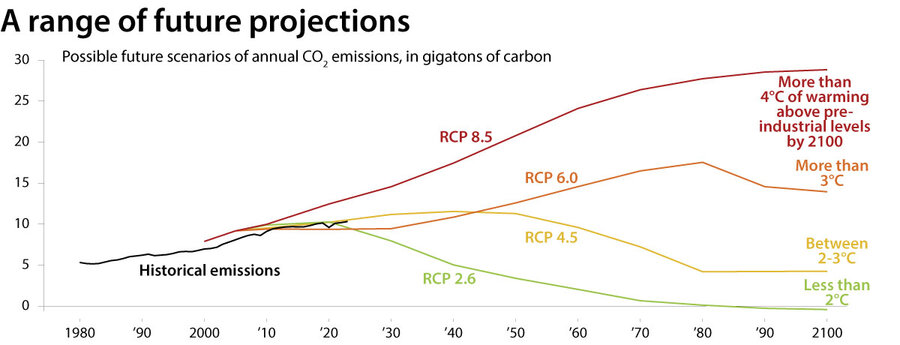
Under this worst-case scenario, referred to in the scientific world as “RCP 8.5,” humans continue to burn fossil fuels with abandon through the 21st century and the world heats up by almost 5 degrees Celsius – or 9 degrees Fahrenheit – above preindustrial levels. On a dystopian RCP 8.5 Earth, Florida’s coastline disappears under water, sub-Saharan Africa witnesses more than 85 million climate migrants by 2050, and half of the world’s plant and animal species go extinct.
It’s a grim forcast. It is also, scientists recently announced, now an “implausible” one.
Why We Wrote This
International scientists decided it is no longer useful to study the most extreme model of runaway global warming. So why are some people upset?
In April, leading scientists for the United Nations Intergovernmental Panel on Climate Change (IPCC) announced that this particular scenario – one of four Representative Concentration Pathways that measure the amount of solar energy trapped in the Earth’s atmosphere under different levels of greenhouse gas emissions – is no longer a reasonable prediction, thanks to the growth of renewable energy and climate policies.
Some have cheered the news, even as scientists in the same report said that the lower-end emission scenario of RCP 2.6, which aligns with a goal of limiting future warming below 2 degrees Celsius, may now be unrealistic as well.
Others in the scientific community have rolled their eyes at this announcement of RCP 8.5’s retirement, arguing that RCP 8.5 has been improbable for several years now. Some even assert that this scenario was never indicative of any possible future, but was disingenuously propped up by climate activists who benefited from the grim attention it brought.
But almost everyone agrees on a fundamental issue: It’s challenging to communicate the complexity and nuance of science to politicians, activists, and the media – especially a science so complicated, and politically charged, as climate change research.
“After [RCP 8.5] was created, through a game of telephone, people started calling it the ‘business as usual’ scenario,” says Zeke Hausfather, a climate scientist who co-authored a 2020 paper arguing that RCP 8.5 was being incorrectly interpreted as our default future without stringent climate mitigation. “It’s useful to have worst-case scenarios. The problem for a while is that people were conflating the worst case with the most likely outcome.”
“Two things can be true”
Back when this model was published in 2011, the line chart of greenhouse gas emissions seemed to be rocketing to the sky with a 30% increase over the previous decade.
But even then, RCP 8.5 set out to show a high-end scenario that relied on an unprecedented fivefold increase in coal use by 2100. Today, “we live in a different world” that uses far less coal, says Dr. Hausfather. So what started as an unlikely worst-case scenario then has become outside of any likely realm of possibility now as renewable energy usage accelerates.
 SOURCE:
RCP Database, Pacific Northwest National Laboratory, U.S.; National Institute for Environmental Studies, Japan; International Institute for Applied Systems Analysis, Austria; Global Carbon Budget
“Two things can be true,” he adds. “The [RCP 8.5] scenario was never intended to be the most likely outcome, and we also have made progress in making high-end scenarios less likely because of falling costs of clean energy, increasing global investments in clean energy, and moving away from fossil fuels.”
Some climate scientists say that the thousands of scientific studies that assessed a RCP 8.5 scenario were not only a waste of time and resources, but also distracted researchers from digging into more moderate scenarios that would be more relevant today.
RCP 8.5 was merely a way to test the model to see what happened when it was pushed really hard, agrees Steven Koonin, who served as Under Secretary for Science, Department of Energy in the Obama administration between 2009 and 2011. Quico Toro with the Anthropocene Institute compared the role of RCP 8.5 to an engineer simulating what would happen if 250 army tanks drove onto a bridge at the same time. That’s not going to happen, but it’s a useful exercise for the engineer to learn about structural weaknesses.
Dr. Koonin says some activists, journalists, and even scientists ran with this scenario to scare the public into reducing emissions, and some “destroyed the reputations of scientists who dared to say, ‘Wait a minute.’”
Not everyone agrees with that point of view, though.
Chris Field, a climate scientist at Stanford University who co-chaired an IPCC working group between 2008 and 2015, refutes any claims that the scientific community deliberately tried to “mislead people” or encourage climate action “by talking about RCP 8.5.” He credits simulations from this high-emission scenario as inspiring the world to help avoid such an outcome.
“We wanted to understand a wide range,” says Dr. Field. “It’s important to recognize that no one in the climate community, certainly not the climate modelers or economists, know what the future trajectory of emissions will be.”
Lessons from 8.5
Climate science is complicated. Not only are Earth’s energy systems complex and intertwined, but they are affected by human behavior. And that, climate scientists say, is incredibly hard to calculate or predict – even if models did not have to consider unknown future societal motivations or policy priorities.
But under current emission trends, the planet looks to be following RCP 4.5, one of the two middle scenarios, expected to bring an average global temperature increase of up to 3 degrees Celsius.
That is “still a very bad outcome,” says Dr. Hausfather.
Every additional bit of warming increases the risk of negative outcomes, he and other climate scientists point out. At just a 2 degrees Celsius increase, studies suggest that there is a greater likelihood of ecological damage such as ocean coral reef collapse. Some studies also suggest that as many as 1 in 4 plant and animal species in the Amazon rainforest and Galápagos Islands could face local extinction. Extreme heat could also impact millions more people and challenge food systems across the world.
And even the RCP 4.5 future assumes that the world continues on the same trajectory of burning less coal and flattening (and later reducing) fossil fuel consumption. The retirement of RCP 8.5’s much more extreme scenario is no reason to backtrack on clean-energy progress, say many climate scientists, even as coal proponents such as President Donald Trump celebrate the news as evidence that climate concerns are overblown.
Deepen your worldview
with Monitor Highlights.
Already a subscriber? Log in to hide ads.
“You have to provide positive pathways”
The real lesson from RCP 8.5 for the next climate model may lie in how it’s communicated to the public while balancing urgency with accuracy. Those activists who conflated the worst-case scenario with the most likely one may have had the opposite of the intended effect, say some scientists.
“[RCP 8.5] was such a scary scenario, requiring so much change of unknown character, that people kind of just threw up their arms and said ‘I’ll leave it to the next generation,’” says Hadi Dowlatabadi, who co-authored a 2017 paper questioning if the world even had the coal reserves needed to power an RCP 8.5 planet. “You have to provide positive pathways for the public rather than scare the bejesus out of them.”