Quest to place the first transatlantic cable reads like an adventure novel
Before the first transatlantic telegraph cable, messages traveled across the ocean by steamship and took about two weeks each way. In 1854, a wealthy paper magnate named Cyrus Field gathered “a scientific ‘dream team,’” including legendary inventor Samuel Morse, to engineer a cable under the Atlantic, creating what might be the greatest technological feat of the 19th century.
In “Lightning Beneath the Sea,” author James M. Tabor argues that Field should be remembered as a champion of scientific ingenuity. From humble beginnings in rural Massachusetts, Field made his fortune in New York City as a paper merchant, retiring as a rich man when he was still in his early 30s. But Field, whose perpetual restlessness had driven his climb to business success, wasn’t suited to sit on the sidelines. He threw himself into the transatlantic cable project, with all its complexities and challenges.
The cable, which began operating in 1858, sparked a communications revolution. For the first time, messages could dart between continents within minutes. “Time and space seem literally annihilated,” a newspaper at the time reported. Harper’s New Monthly Magazine was equally ecstatic, declaring that “the Atlantic Ocean has been abolished.”
Why We Wrote This
Cyrus Field, a wealthy paper magnate, gathered “a scientific ‘dream team’” to engineer a cable under the Atlantic, a Promethean project that would have daunted lesser individuals. Author James M. Tabor argues that Field should be remembered as a champion of scientific ingenuity.
In the tradition of David McCullough’s “The Great Bridge” and “The Path Between the Seas,” which chronicled, respectively, the construction of the Brooklyn Bridge and the Panama Canal, Tabor casts the trial-and-error struggles involved in Field’s massive construction project as an epic adventure. Tabor, like the late McCullough, appears particularly suited to this kind of narrative. In “Blind Descent,” his 2010 book about explorers who ventured to the world’s deepest undersea caves, Tabor proved adept at conveying the intricacies of the nautical depths.
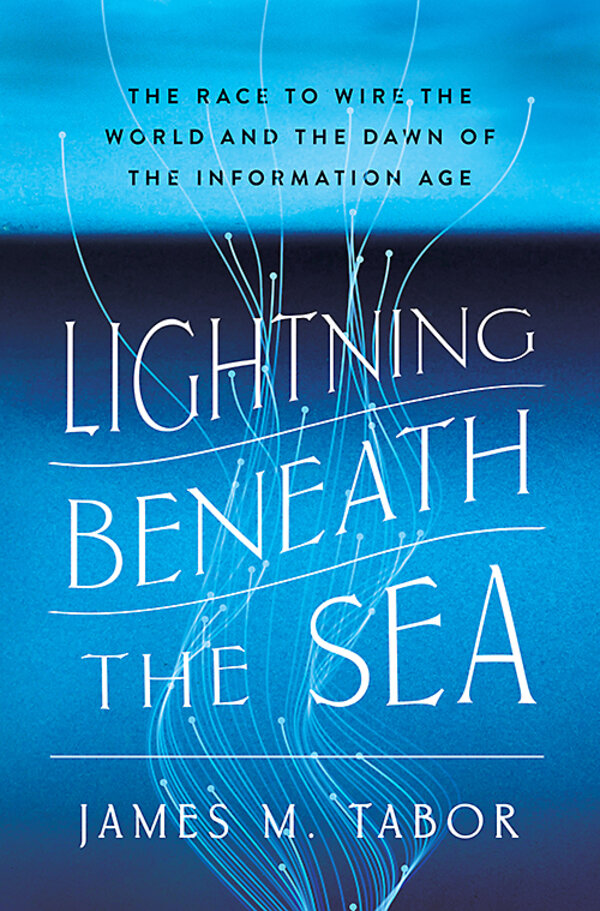
Tabor’s work in TV documentary has also sharpened his skills at explaining technical processes to a general audience. In touching on the enormous water pressure straining cables at ocean depths, for example, he compares the stress to “a large SUV balanced on a domino.” Bright bits of science fact shimmer throughout these pages like schools of herring. Among other things, we learn that in a world where modern synthetic polymers had yet to be developed, Field’s contemporaries had to devise a way to insulate undersea cables. They landed on gutta-percha, a resin made from trees “which grow naturally only in Malaysia and Indonesia.” Tabor tells readers: “Without gutta-percha, none of the early submarine telegraph cables, including Field’s, would have been possible.”
Ultimately, though, “Lightning Beneath the Sea” resonates most vividly in detailing the personal ordeals and rivalries that proved as thorny as the logistical hurdles.
In Tabor’s telling, Field comes off as a figure of Shakespearean tragedy, someone whose strengths would paradoxically become his undoing. “I never saw Cyrus so uneasy,” Field’s brother Matthew once noted, “as when he was trying to keep still.”
Field’s legendary tenacity galvanized his will to complete a project that appeared quixotic to many others. After he floated the concept of a transatlantic cable, one newspaper, expressing a common sentiment, described it as “utterly impracticable and absurd.” But Field’s exuberance, though it sustained him through huge setbacks, could also be grating. After his first transatlantic cable foundered, he sought new champions for his endeavor, including President Abraham Lincoln. Though celebrated for his affability, Lincoln grew exasperated with Field’s rapid-fire delivery, waving him away.
Such details make Tabor’s book a gripping yarn, one he occasionally oversells. “Global commerce did not exist,” he boldly declares in describing the world before Field’s cable spanned an ocean. Perhaps it’s more accurate to say that global trade existed, though at a much slower pace. Sometimes, Tabor can be overly speculative. “On that halcyon morning, failure could not have been farther from his thoughts,” he writes of Field on his maiden voyage for the project. For the author to purport to understand Field’s inner life at such a moment could be a stretch.
Deepen your worldview
with Monitor Highlights.
Already a subscriber? Log in to hide ads.
This might be especially true of Field himself, whose voluble spirit shaped an equally volatile life. Its highs and lows defy easy summary here, and watching them unfold is a sustaining tension within Tabor’s story.
“Lightning Beneath the Sea” is more than a quaint period piece. Undersea cables, after all, continue to help define modern communications, even in an age of satellites. “People think that data is in the cloud, but it’s not,” a Google executive points out. “It’s in the ocean.”