Here’s where Trump has canceled wind farms – and how states are pushing back
President Donald Trump’s opposition to offshore wind farms is well-documented. In the early 2010s, he sued the Scottish government when it gave permission for a company to build turbines in sight of one of his resorts. In public testimony over the years, the president has called wind turbines “monstrosities.” He has fretted about their environmental impact, decried their noise, and lamented their impact on tourism.
He lost his case in Scotland. Now, as U.S. president, he has more leverage.
Over the past year, the Trump administration has gone to great lengths to undo his predecessor’s efforts to establish a wind power industry off the coast of the United States. Since March, he’s struck five agreements with private companies to cancel at least nine offshore wind leases – a strategy that rings of Mr. Trump’s tendency toward dealmaking and that environmental policy analysts say no president has employed before.
Why We Wrote This
President Donald Trump has directed the U.S. government to pay billions to halt wind energy projects. The deals involve redirecting funds toward fossil fuels and other conventional energy projects. In response, some states have sued.
Clean energy advocates have decried the agreements. They argue that blocking wind projects will hobble the country’s ability to reduce the greenhouse gas emissions driving a warming climate, while also eliminating a technology that could reduce energy prices. The Trump administration, by contrast, has argued that the president’s shift back to fossil fuels will reduce costs and boost energy reliability.
 Carolyn Kaster/AP/File
“It’s the government saying that we’re going to incentivize these developers to voluntarily give up their offshore wind leases, so that they could use that money instead to invest in fossil fuel or conventional energy projects,” says Austin Gae, who studies energy policy at Advancing American Freedom, a conservative think tank. “I see this tug-of-war from one administration to the next.”
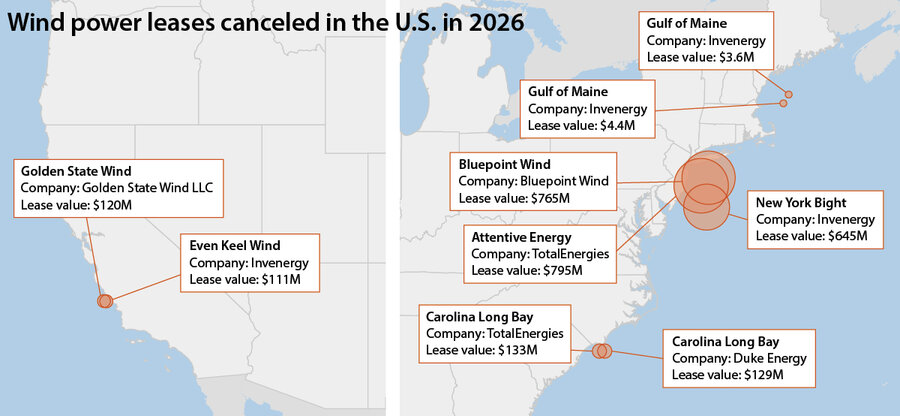
In the first deal, the Trump administration agreed to refund TotalEnergies, a French energy company, $928 million for two offshore wind leases. In exchange, the company reinvested that money into fossil fuels. Subsequent agreements have followed a similar model, involving wind farms from Maine to North Carolina to California, at various stages of development. In all, the Trump administration has, since March, pledged to refund more than $2.7 billion.
“These buyouts, which use taxpayer dollars, really hit consumers twice,” says Phelps Turner, senior attorney for U.S. energy policy at the Environmental Defense Fund. “They prevent the development of low-cost sources of electricity – that is, offshore wind. And second they’re being paid for by taxpayers.”
Whether Mr. Trump’s new strategy could impact other renewable energy sources remains to be seen, Mr. Turner says. The legality of the approach is unclear, and not all renewable energy projects require lease payments that could be refunded. In general, the president can only spend money that Congress has appropriated.
Taken together, the canceled wind projects could have powered some 7 million homes across the country, according to project documents. All of the leases, which the Bureau of Ocean Energy Management issues to companies to develop renewable energy in coastal waters, were awarded under President Joe Biden. His administration had set a goal of developing at least 30 gigawatts of offshore wind power, which it called “enough to power 10 million homes,” by 2030.
During its four-year tenure, the Biden administration issued leases for at least 23 offshore wind farms, compared with five during Mr. Trump’s first term and 24 under Barack Obama, according to documents from the Bureau of Ocean Energy Management.
Although the Trump administration has pledged billions to cancel the wind leases, the companies also seem to be losing money. While the agreements say the administration will reimburse companies after they reinvest in “conventional energy projects,” up to the value of their original leases, that doesn’t cover expenses that companies incurred beyond the original lease payment.
For example, an agreement with Invenergy over a farm off the coast of California says the company spent nearly $27 million for “preliminary project development” and almost $724,000 for “annual lease payments” that companies must pay in addition to their initial fee. The agreement only requires the government to repay the $111.7 million Invenergy first paid to acquire its lease.
Deepen your worldview
with Monitor Highlights.
Already a subscriber? Log in to hide ads.
The reimbursements draw from the taxpayer-supported Judgment Fund, which federal law allows the government to use to settle court cases.
 SOURCE:
Bureau of Ocean Energy Management, U.S. Department of the Interior
In June, seven states in the Northeast sued the Trump administration, accusing it of violating federal law, in part, by misusing the Judgment Fund. The Trump administration has not yet responded to that suit. Earlier this month, those same states, plus Delaware, filed notices of intent to sue the U.S. Department of the Interior over other canceled offshore wind leases. Those actions come after judges ruled against the government in five separate legal cases over a work stoppage it issued to farms off the East Coast last year.
In New England, which has emerged as the country’s epicenter of offshore wind, advocates and climate researchers have argued the technology is crucial to reducing high costs and improving reliability. In February, a study by the Union of Concerned Scientists found that two offshore wind farms would have reduced the risk of demand-driven blackouts by 55% during the winter of 2024-25, when energy needs spiked for heating. Massachusetts leaders have said that Vineyard Wind, a farm operating near Cape Cod, would save Bay Staters some $1.4 billion over the next 20 years.