The 1909 auto race that sealed Americans’ love of cars
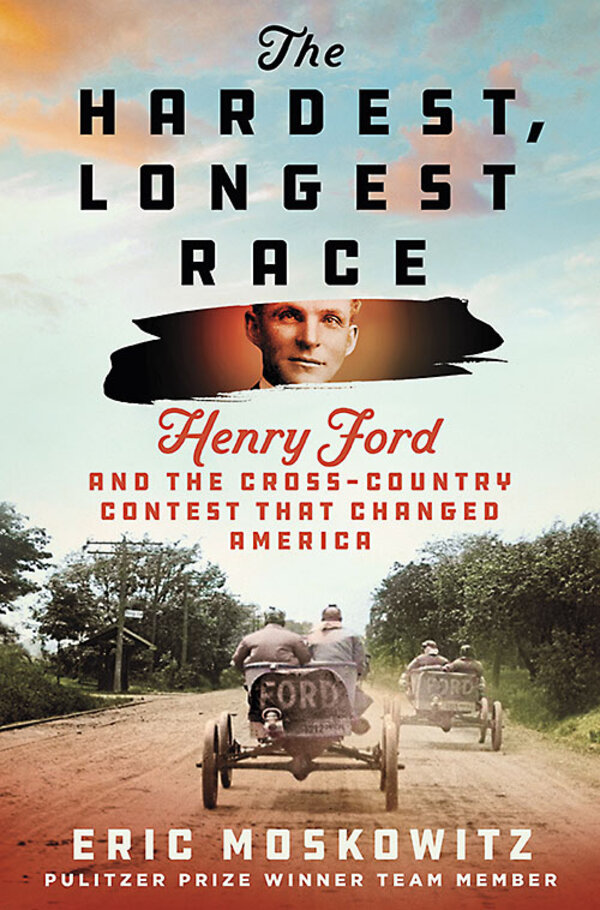
As gasoline prices soar and inflation nips at vacation budgets, many travelers may have rethought the prospect of the Great American Road Trip. But in “The Hardest, Longest Race,” a charming account of a topsy-turvy automotive contest that captured the national imagination, author Eric Moskowitz reminds readers that getting behind the wheel in 1909 had its challenges, too.
That’s the year when millionaire M. Robert Guggenheim staged a contest to see which motorists could travel most quickly between New York City and Seattle, which seemed an ideal finish point because it was hosting a world’s fair. The course zigzagged more than 4,100 miles across the continent – a formidable journey, though one that many cars today could handle without a hiccup. But autos were precarious contraptions at the start of the 20th century, and America’s national system of roads was little more than a faint scribble on the map. When Guggenheim summoned contestants to the starting line on the first day of June outside City Hall in Manhattan, only four car companies – Acme, Ford, Shawmut, and Itala – dared to show up. Henry Ford hedged his bets by entering two of his Model Ts in the race.
Though Ford remains a global brand, few readers will recall Shawmut or Acme, and their brief moment is also part of Moskowitz’s story. As he explains, America had 253 automakers in 1909. It was a precursor of sorts to today’s Silicon Valley startup culture, in which a million entrepreneurial flowers bloom, with many quickly withering on the vine. Interestingly, Moskowitz learned the scale of the automotive sector all those decades ago by consulting a period survey meant to drum up congressional support for tariffs.
Why We Wrote This
“The Hardest, Longest Race” takes readers on a wild jaunt across the country, on roads that could hardly live up to the name. With its hairpin turns and madcap improvisations, the odyssey at the book’s center can seem, says our reviewer, like something sketched out by Jules Verne.
That tidbit seems like something pulled from this morning’s headlines, but in many other ways, “The Hardest, Longest Race” reveals a time sharply different from our own. Race contestants could buy gas at a now-enviable 15 cents a gallon, but filling stations were a rarity. Some motorists replenished their tanks at hardware stores, where gas was often ladled from a barrel.
Speed limits of the day seemed similarly improvised. In Ohio, drivers could go no more than “eight miles per hour in densely settled districts, fifteen in outlying areas, and twenty in the country, with an added requirement to slow near any horse and to stop fully if the person with the horse signaled you to do so.”
American transportation was still largely equestrian. When President William Howard Taft asked Congress to fund the first White House limousines, one member of Congress dismissed automobiles as “a genuine all-around nuisance” and advised the president to get some mules instead.
Mules still seemed better suited to much of the era’s transportation grid. When local journalists in Ohio tagged along for part of the 1909 race after a spell of rain, “the Maumee Pike macadam was a mess,” Moskowitz tells readers. “The newspapermen clung to their seats ‘over roads flooded and over bumps that threatened a hundred times to hurl the drivers into the ditches.’”
Moskowitz often quotes from community newspapers along the race route – many no longer around, though their lively legacy happily endures in digital archives. Their content is a reminder that scribes more than a century ago often had a flair for colorful language. It’s a sense of whimsy that Moskowitz, a former Boston Globe reporter, embraces in his own prose. Here’s how he playfully describes the race’s sponsor: “An Edwardian dandy of gleaming stickpins and crisp club collars, Guggenheim sported a dusting of beard, a straw boater, and a lapel carnation as big as a saucer.”
This is a fun and fizzy book. The quixotic odyssey at its center, with its hairpin turns and madcap improvisations, can seem like something sketched out by Jules Verne.
Deepen your worldview
with Monitor Highlights.
Already a subscriber? Log in to hide ads.
The subtitle of “The Hardest, Longest Race” bills it as “the cross-country contest that changed America.” The premise sounds oversold, especially since the end of the race was something of a fizzle. One of Ford’s Model T’s initially landed in first place, but the victors were later disqualified because Ford’s team hadn’t followed the rules.
Moskowitz’s book is a timely reminder that though some of the American romance with cars might be fading, we’re in what could be the golden age of automotive history books. Witold Rybczynski’s “The Driving Machine” and Brian C. Black’s “Ike’s Road Trip” count as memorable recent examples, and “The Hardest, Longest Race” is a worthy addition to the mix.