Iran war is exposing Europe's military limits.
The European Union is grappling with some of the same frustrations facing President Donald Trump in his war against Iran: European leaders unwilling or simply unable to share military resources, even with each other.
In cases of war assistance, these resources – from warships to tanks – have sometimes been removed from service for reasons beyond the control of the U.S. or its allies. The Pentagon, for example, was forced to withdraw its B-1 long-range bombers last weekend from Royal Air Force base Fairford, about 100 miles west of London, following an alleged terrorist plot in which five men were arrested.
Meanwhile, along the Red Sea, Yemen’s Tehran-allied Houthi rebels have been stepping up attacks on European commercial ships transiting the Bab el-Mandeb Strait. This strategic waterway has become more important still as the war in Iran disrupts transit through the Strait of Hormuz, through which about one-fifth of the world’s oil has traditionally flowed.
High fuel prices and an Iran war stalemate give Europe an incentive to try to help end the conflict. But low defense spending has left Europe with weak naval resources.
To support defense, France, Greece, and Italy in 2024 launched Operation Aspides, a naval mission to protect the EU’s interests in the Red Sea and surrounding trade corridors, including escorting commercial ships.
But as the Middle East conflict has widened, amid renewed Houthi strikes, Europe is feeling pressure to do more. The U.S.- and Israel-led mission still lacks ships, but defense spending cuts have left much of the continent with weak navies. That is raising frustrations in European capitals and in the U.S. about what kind of credible military help Western allies can – and will – provide to help end the Iran war moving forward.
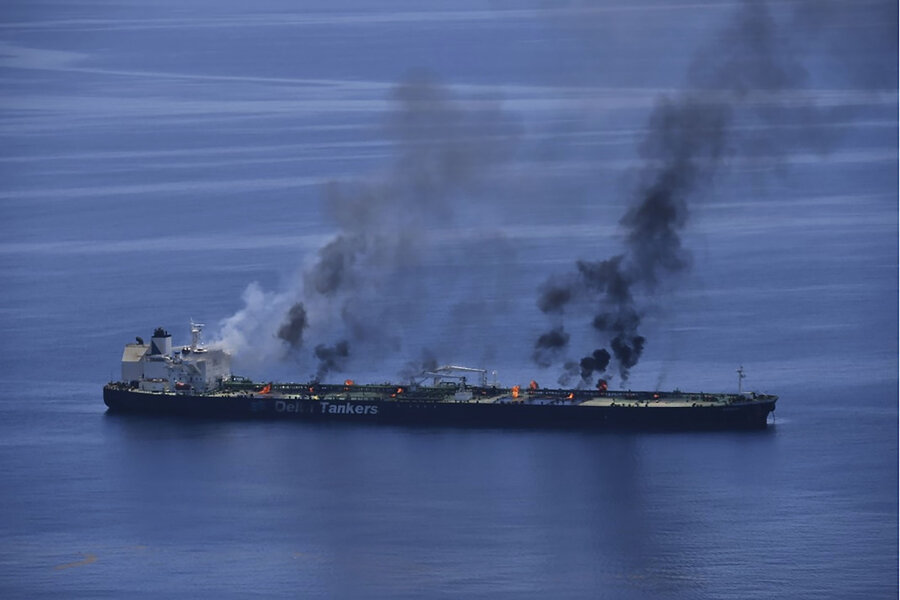 European Union's Operation Aspides/AP/File
Indeed, for months now there has been a sense that Europe would “never act in the Middle East” because of resentment over what they see as President Trump’s “dumpster fire” of a war with Iran, says Edward P. Joseph, senior fellow at the Foreign Policy Institute, a nonpartisan think tank in Washington.
Yet with rising fuel prices and other interests at stake, Europe is increasingly pushing for action, including possibly using “psychological leverage” that could pressure Iran to negotiate, Mr. Joseph says.
“That’s what’s needed to end this thing,” he adds. “Europeans no longer have the luxury of ‘letting the Americans deal with the Iran problem they created.’”
Building a defense threat
Shortly after the war started, France and Britain began assembling a multinational force to provide security in the Strait of Hormuz – to be deployed once the war is over.
More than 20 countries have signed on, but in an effort to spur European action sooner, NATO’s Supreme Allied Headquarters in August convened a “group of interested allies … to facilitate their possible contributions in support of freedom of navigation” in the region “before the French and U.K.-led initiative, the Multinational Military Mission, commences,” Col. Martin O’Donnell, A NATO spokesperson, told The Monitor in a text message.
Meanwhile, Italian Defense Minister Guido Crosetto expressed frustration last month with fellow Europeans over their lack of contributions to Operation Aspides. “We need more ships,” he said in a Reuters interview. “The only nations really supporting [the efforts] are Italy and Greece.”
EU foreign policy chief Kaja Kallas seconded this sentiment in a letter last month to Europe’s 27 member states asking for more resources for Aspides, to ensure the mission has the support of at least 10 ships.
Mr. Crosetto said that Italy planned to forge ahead with action, instead of waiting around for “European bureaucracy” or NATO countries to lead or devise a plan.
Coordination matters
It doesn’t help, analysts add, that the EU is trying to gather ships for Aspides even as France and the United Kingdom have put together a separate initiative. Their Multinational Military Mission, an ad hoc coalition to clear mines and secure the Strait of Hormuz, is competing for European naval resources.
But it’s more than bureaucracy preventing European naval action in the region, analysts say. The EU, for starters, doesn’t have its own pool of European warships, so member states must voluntarily offer up their own. Some smaller European states have only one warship.
Other landlocked countries, like Austria and Hungary, have none. Malta, Cyprus, and Ireland have their own naval forces, but not the sort of frigates or destroyers needed for high-threat escort operations.
How Europe’s ships could help
The effort behind missions such as Aspides is a step in the right direction, says retired Rear Adm. Mark Montgomery, senior fellow at the Foundation for the Defense of Democracies think tank in Washington. European navies that contribute to the mission “would lessen the load on the United States Navy so it can do more in the Strait of Hormuz.”
But in taking on other missions, Europe is constrained by the generally “horrific condition” of its navies, he adds, which have historically borne the brunt of scaled-back defense spending. Still, Europe can take steps now, Mr. Joseph says, including establishing an official “fleet in being,” a “classic naval posture” that taps into Iran’s “demonstrable fear” of Europe being pulled into the war.
That means Europe’s ships would stay in port, or nearby, but remain ready to intervene if needed. Such a posture would communicate looming but restrained potential for attack or counterattack, he adds, giving Europe leverage by creating more uncertainty in Tehran and boosting confidence in the Hormuz shipping lanes.
Deepen your worldview
with Monitor Highlights.
Politics with respect
Get political stories with respectful analysis.
There‘s a world of new ideas in every
Books newsletter.
There‘s more to life, enrich yours with
Culture & Learning weekly.
Follow humanity‘s discoveries with
Science & Nature stories in your inbox.
Gain a spiritual perspective
from the stories in your inbox.
Want to understand the deeper impact of critical events? Learn the Monitor‘s insight.
Already a subscriber? Log in to hide ads.
Iran has shown that “they’re very cautious about attacking” America’s NATO allies in Europe for fear of bringing them into the war,” Mr. Joseph says. Tehran “cannot just blow [European ships] out of the water, because if they do, then they’re engaging NATO in this thing” through Article 5, which states that an attack on one is an attack on all.
This will in turn “exploit Iran’s fear of them entering the war alongside the U.S.,” he argues. “That’s Iran’s vulnerability.”
ALREADY A SUBSCRIBER? Login